
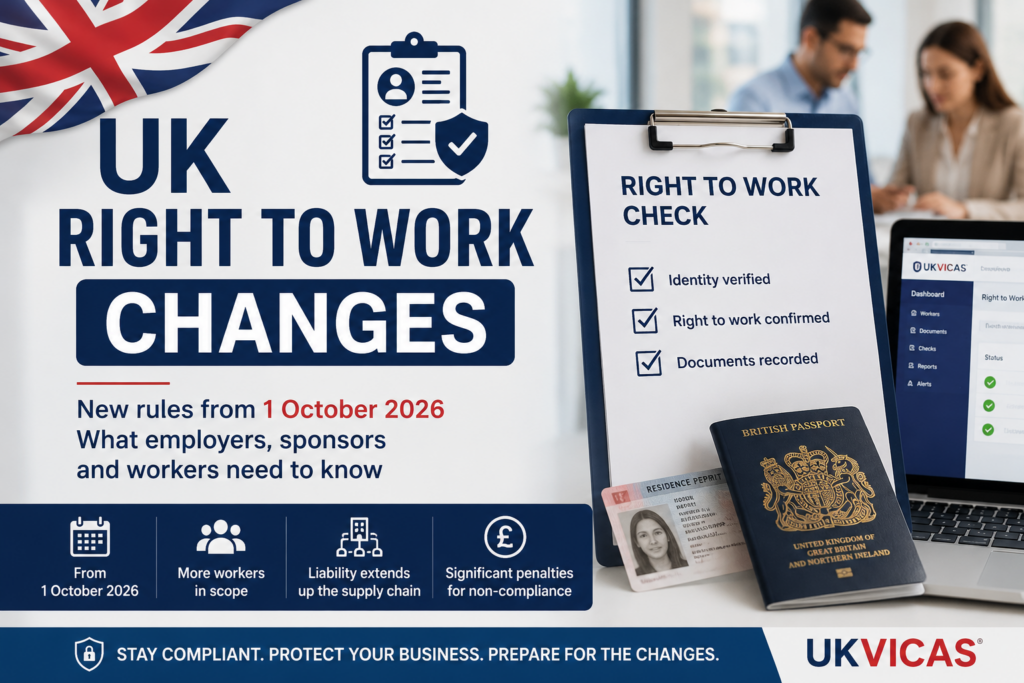
The UK’s Right to Work rules are changing from 1 October 2026. Employers, HR teams, sponsor license holders, labor suppliers, and migrant workers should understand how these changes may affect recruitment, compliance responsibilities, and record-keeping. Preparing early can help reduce compliance risks, avoid significant civil penalties, and support ongoing sponsor license compliance.
What’s Changing and Why It Matters
From 1 October 2026, the UK Government is expanding the scope of the Right to Work regime under Section 48 of the Border Security, Asylum and Immigration Act 2025.
The changes go beyond traditional employees. Businesses engaging contractors, subcontractors, labour-only workers, and certain platform workers may also need to carry out Right to Work checks.
Another significant change is that responsibility may no longer rest solely with the direct employer. In some cases, civil penalty liability can extend through the labour supply chain, meaning organisations using agencies or outsourced labour could also face compliance risks.
Failure to carry out compliant Right to Work checks may result in:
- Civil penalties of up to £60,000 per illegal worker
- Potential criminal liability where illegal working is knowingly permitted
- Increased compliance risks for sponsor licence holders
- Reputational and operational disruption
For businesses relying on temporary labour, contractors, or sponsored workers, reviewing compliance processes before October 2026 is becoming increasingly important.
Who Is Affected?
Employers and HR Teams
If your organisation recruits or manages workers through different engagement models, these changes are likely to affect you.
Examples include:
- Agency workers
- Contractors
- Consultants
- Temporary workers
- Platform workers
- Labour-only workers
HR teams may need to:
- Review Right to Work procedures
- Monitor time-limited permissions
- Improve record keeping
- Strengthen identity verification
- Review supplier compliance
Sponsor Licence Holders
Businesses sponsoring Skilled Workers already have immigration compliance duties.
The new Right to Work changes sit alongside these existing responsibilities.
Sponsor licence holders should consider:
- Reviewing Right to Work processes
- Checking labour supply chain arrangements
- Ensuring sponsored worker records remain accurate
- Maintaining evidence for future Home Office compliance visits
Strong documentation and digital record management can help demonstrate ongoing compliance.
Labour Suppliers and Recruitment Agencies
Agencies and labour suppliers may receive additional contractual requirements from clients.
These may include:
- Evidence that Right to Work checks were completed
- Audit rights
- Restrictions on subcontracting
- Identity verification procedures
- Information-sharing obligations
Having consistent compliance processes across the supply chain will become increasingly important.
Migrant Workers and Job Seekers
If you have permission to work in the UK, you may notice employers requesting additional documentation or carrying out repeat checks.
This does not necessarily mean there is a problem with your immigration status.
To help employers meet their legal obligations, you should:
- Keep immigration documents up to date
- Inform your employer of visa changes
- Understand any conditions attached to your permission to work
- Respond promptly when employers request updated documents
Employers should carry out Right to Work checks fairly and consistently, regardless of nationality or ethnicity.
How the New Right to Work Regime Works
How does the current Right to Work system work?
Before employment begins, employers must complete a compliant Right to Work check following Home Office guidance.
Where an individual has permanent permission to work, the employer generally establishes a continuous statutory excuse.
Where permission to work is time-limited, follow-up checks must usually be completed before the permission expires to maintain that protection.
Completing compliant checks helps protect employers from civil penalties if illegal working is later identified.
What Does Section 48 Change?
From October 2026, the Right to Work regime expands to include additional working arrangements.
The proposed changes cover:
- Workers engaged under contracts for services
- Individual subcontractors
- Workers engaged through online matching platforms
The draft Code also indicates that genuinely self-employed individuals operating their own independent business and contracting directly with clients generally remain outside the scope.
Can Liability Extend Beyond the Direct Employer?
Yes.
One of the most significant changes is that civil penalty liability may extend beyond the organisation with the direct contractual relationship.
Businesses using:
- Recruitment agencies
- Labour providers
- Contractors
- Subcontractors
may all have greater compliance responsibilities depending on how labour arrangements operate in practice.
What Happens If Right to Work Checks Are Not Completed Correctly?
Potential consequences include:
- Civil penalties of up to £60,000 per illegal worker
- Criminal liability where illegal working is knowingly permitted
- Increased Home Office scrutiny
- Potential sponsor licence compliance concerns
Accurate record keeping and timely follow-up checks remain essential.
Practical Steps for Employers and Sponsor Licence Holders
1. Audit Your Workforce and Labour Supply Chain
Review every way your organisation engages workers, including:
- Employees
- Contractors
- Consultants
- Agency workers
- Platform workers
- Subcontractors
Identify who currently performs Right to Work checks and where compliance gaps may exist.
2. Review Contracts with Agencies and Labour Suppliers
Consider whether agreements clearly require:
- Right to Work checks before work starts
- Restrictions on further subcontracting without written approval
- Equivalent compliance obligations throughout the supply chain
- Audit rights
- Appropriate enforcement provisions where illegal working is identified
For sponsor licence holders, well-documented contracts can also support wider compliance evidence.
3. Strengthen Identity Verification and Substitution Procedures
Where substitution is permitted, employers should ensure substitute workers are verified before commencing work.
Practical measures may include:
- Staff identification cards
- Workplace access passes
- Cross-checking training records
- Periodic identity verification
Employers should avoid relying solely on the original worker to confirm the substitute’s Right to Work.
4. Prepare Your Compliance Systems
As more worker categories come within scope, organisations should assess whether current compliance processes can support the increased workload.
This may include:
- Digital document storage
- Automated visa expiry reminders
- Right to Work tracking
- Staff training
- Internal compliance reporting
Using digital compliance systems can help HR teams manage larger workforces more efficiently while maintaining accurate records.
What Migrant Workers Should Know
Why is my employer asking for additional documents?
The law is changing, and employers may need to verify the Right to Work status of more categories of workers. These checks help employers meet their legal obligations.
What should I bring to a Right to Work check?
Bring the documents or digital evidence requested by your employer, such as a valid passport, eVisa information, or a Home Office share code where applicable.
Can I be treated differently because of my nationality?
No. Employers should apply Right to Work checks consistently to all relevant workers to avoid unlawful discrimination.
Frequently Asked Questions
We use many independent contractors. What should we do?
Review whether those contractors fall within the new rules and ensure your Right to Work procedures and contracts reflect the updated requirements.
We hold a sponsor licence. What should we prioritise before October 2026?
Review sponsored worker records, assess labour supply chain arrangements, update internal Right to Work procedures, and ensure compliance documentation is complete.
We rely on labour supplied by agencies. What should we ask them?
Confirm how Right to Work checks are carried out, what records are retained, whether audit rights exist, and how subcontracting is managed.
I have a time-limited visa. Will my employer check my documents again?
Possibly. Employers are generally required to carry out follow-up checks before time-limited permission to work expires to maintain compliance.
Preparing for October 2026
Although the new rules take effect on 1 October 2026, organisations can benefit from reviewing their compliance processes well in advance.
Employers should assess their workforce arrangements, strengthen supply chain governance, and ensure Right to Work records remain accurate and accessible. Sponsor licence holders should also review immigration compliance processes alongside their wider sponsorship duties.
Digital compliance platforms such as UKVICAS can help organisations centralise Right to Work records, monitor visa expiry dates, automate reminders, securely store supporting documents, and maintain audit-ready compliance evidence—helping HR teams reduce administrative effort while supporting ongoing Home Office compliance.
Sources
This article is intended as general information and should not be considered legal advice.
Key references include: