
1. The Shifting Sands of the UK Dream
The UK migration landscape is changing — fast.
Thousands of skilled workers, students, and entrepreneurs who built their lives in Britain now face growing uncertainty. What once felt like a clear five-year path to permanent residency now looks like a moving target.
As enforcement tightens and new financial barriers emerge, many migrants are asking a difficult question: Is the UK still open to global talent?
2. The 10-Year Wait: Doubling the Road to Settlement
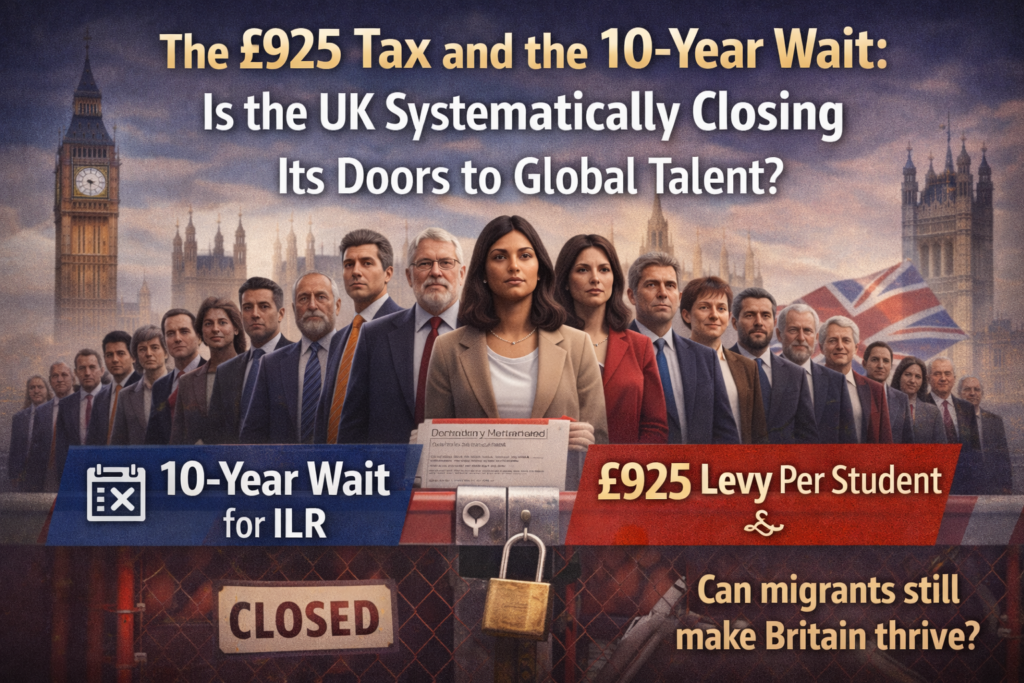
At the heart of the debate lies a dramatic proposal — extending the qualifying period for Indefinite Leave to Remain (ILR) from five years to ten years.
If implemented, this change would double the time skilled workers must remain tied to employer-sponsored visas. As a result, migrants would face prolonged restrictions, extended employer dependency, and increased financial costs.
Why now?
The government aims to manage the estimated 1.6 million migrants approaching ILR eligibility while reducing net migration numbers. However, critics argue that changing the rules mid-journey undermines trust.
Political pressure is mounting. Home Secretary Shabana Mahmood has received strong cross-party objections, yet she has not confirmed whether “grandfathering” protections will apply to those who arrived between 2021 and 2025.
That silence has created legal limbo for thousands.
3. The Sponsor Crackdown: 1,928 Licences Revoked
Meanwhile, enforcement has intensified.
During 2024–2025 alone, the Home Office revoked 1,928 sponsorship licences. Authorities have heavily targeted the care sector, alongside food delivery businesses, car washes, and salons.
Even more significantly, the government has removed the one-year “cooling-off” period. Previously, businesses could reapply after 12 months. Now, serious breaches may trigger indefinite bans.
Compliance inspections have also grown more aggressive. In one London case, authorities used CCTV footage to prove a student exceeded the 20-hour work limit. Officials cancelled the visa immediately and imposed a substantial fine on the employer.
Common triggers now include:
- Hiring workers without verified right-to-work checks
- Paying “cash in hand” to avoid tax obligations
- Paying below the salary stated on the Certificate of Sponsorship (CoS)
- Failing to monitor international students’ permitted work hours
⚠️ Employers now face fines of up to £60,000 per illegal worker.
Clearly, sponsor compliance has never carried higher stakes.
4. The £925 Student Levy: A Strategic Deterrent?
In 2028, the government plans to introduce a £925 levy per international student, payable by universities.
Although institutions will technically pay the charge, most analysts expect universities to pass the cost directly to students through higher tuition fees.
Consequently, the UK may become less competitive compared to Canada and Australia.
Supporters argue the measure protects domestic infrastructure. Critics, however, see something different: a calculated attempt to reduce international student numbers by raising the financial barrier.
Either way, the message feels clear — migration will cost more.
5. The 60-Day Clock: When Compliance Fails
Perhaps the most alarming risk affects skilled workers whose employers lose their sponsor licence.
If that happens, the worker’s visa faces curtailment. They typically receive a 60-day deadline to secure a new sponsor, switch visa routes, or leave the UK.
Imagine building a life for four or five years — paying taxes, renting a home, enrolling children in school — only to face removal because of an employer’s compliance failure.
Unlike asylum applicants, who retain legal status while awaiting decisions, skilled workers can fall into overstayer status quickly.
As a result, their entire future can depend on two months.
6. The Entrepreneurial Exit: 6,000 Businesses Leave
The impact extends beyond employees.
Over the past two years, approximately 6,000 entrepreneurs have relocated their businesses abroad. Rising corporate taxes, increased hiring costs, and visa complexity have pushed founders to consider alternative hubs.
Countries like the UAE and Ireland now actively court the same global talent.
Therefore, the UK risks losing not only migrants — but investment, innovation, and job creation.
7. So What Happens Next?
The government insists these measures will create a “controlled and sustainable” migration system. Yet critics warn of unintended consequences:
- Longer settlement routes may reduce retention in essential sectors
- Higher student costs could weaken university revenues
- Stricter compliance rules may discourage sponsorship altogether
- Entrepreneurs may continue relocating abroad
Ultimately, the UK faces a balancing act.
Stronger enforcement may reduce net migration figures. However, it could also weaken the very sectors that depend on global expertise.
Final Thought
The real question isn’t whether migration numbers will fall.
It’s whether Britain can afford the cost of pushing away the skilled workers, students, and entrepreneurs who power its economy.
The next few months — especially upcoming policy clarifications — will determine whether the UK remains a global talent hub or becomes a harder destination to justify