
Introduction: UK Employer Compliance Is Now Under Direct Enforcement Pressure
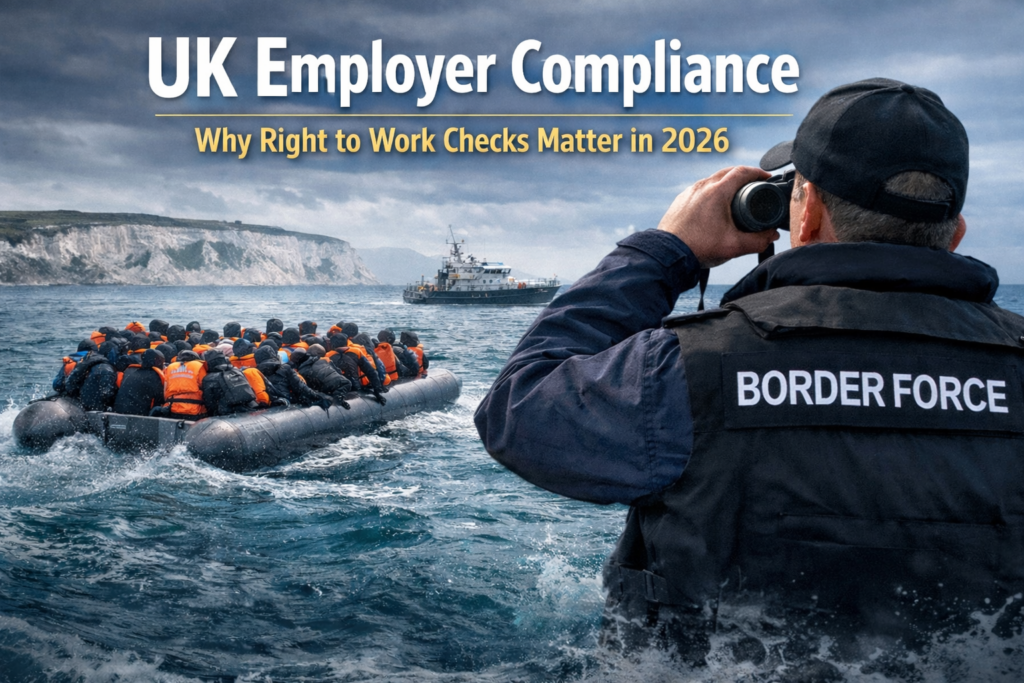
UK employer compliance has become a frontline enforcement priority as migration trends shift and removals accelerate. Although January small boat arrivals have declined from their 2024 peak, government enforcement has not slowed. Instead, the Home Office has intensified workplace scrutiny to meet removal and deterrence targets.
As a result, Right to Work checks now play a central role in enforcement outcomes. For sponsor licence holders, compliance is no longer administrative. It is operational risk control.
At UKVICAS, we consistently observe the same pattern. When border pressure increases, enforcement pivots inward. Employers who fail to evidence compliance become immediate targets.
January Migration Trends (2021–2026): What Employers Must Understand
January migration data between 2021 and 2026 shows sharp volatility followed by stabilisation.
- January 2021: 224 arrivals
- January 2024: 1,335 arrivals (peak)
- January 2025: 1,098 arrivals
- January 2026: 933 arrivals (lowest January since 2021)
This represents a 30% reduction from the 2024 peak.
However, lower arrivals do not mean reduced enforcement. Instead, the decline reflects aggressive intervention, including adverse weather conditions and enhanced UK–France operational cooperation.
Crucially, a Home Office spokesperson confirmed that enforcement disrupted logistics — not demand. This distinction matters because it drives where enforcement resources are redirected next.
Enforcement-First Strategy and the “One In, One Out” Policy
While arrivals fell, enforcement activity expanded significantly.
Confirmed Home Office outcomes include:
- 40,000 attempted crossings disrupted
- Nearly 50,000 individuals detained and removed
- Implementation of the “one in, one out” pilot scheme
Under this pilot:
- New arrivals are detained immediately
- Returns to France occur within two weeks
- The UK accepts only asylum cases with strong merit
So far, 281 migrants have been returned to France under this framework.
Because removal targets now define success metrics, enforcement teams seek fast, provable results. Workplaces provide exactly that.
2025 Migration Pressure and Why Employers Are Exposed
January data must be viewed within the wider 2025 context.
During 2025, 41,472 migrants crossed the Channel, nearly 5,000 more than in 2024. This volume strained Border Force operations, including temporary landing shifts from Dover to Ramsgate.
When border operations strain, enforcement activity shifts toward:
- Employers
- Payroll systems
- Right to Work documentation
- Sponsor licence compliance records
As a result, UK employer compliance becomes an enforcement multiplier.
Why UK Employer Compliance Risk Has Increased in 2026
Political pressure to deliver removals has created a clear enforcement pattern. The Home Office prioritises low-resistance targets — employers unable to evidence compliance.
This shift forces employers to move from:
❌ Passive administration
✅ Active compliance risk management
At this stage, UK employer compliance and Right to Work checks form the first line of defence against inspections, penalties, and licence action.
Right to Work Checks: The Core of Employer Compliance Protection
Right to Work checks now sit at the centre of employer enforcement strategy.
As removals increase, the Home Office intensifies scrutiny to identify illegal working. Even a single onboarding failure can trigger:
- Civil penalty investigations
- Sponsor licence reviews
- Wider compliance audits
Therefore, RTW checks are no longer HR formalities. They are legal safeguards.
Statutory Excuse: The Only Legal Shield Available
Under the UK Civil Penalty Scheme, employers gain protection only by completing a compliant Right to Work check before employment begins.
A valid statutory excuse:
- Protects against penalties of up to £60,000 per worker
- Safeguards sponsor licences from suspension or revocation
- Demonstrates proactive UK employer compliance during inspections
Without it, intent is irrelevant. Evidence decides outcomes.
Maintaining Sponsor Compliance in a Crackdown Environment
For sponsor licence holders, compliance protects more than finances. It preserves:
- Recruitment capability
- Operational continuity
- Long-term access to global talent
Employers that exceed minimum Home Office standards consistently withstand audits. Others struggle under strict deadlines and documentation demands.
At UKVICAS, the contrast is clear.
Employer Compliance Checklist (Immediate Action)
HR and compliance teams should confirm the following:
- ✅ Verify identity using original documents or the Home Office online RTW service before employment starts
- ✅ Apply RTW checks consistently across all employees
- ✅ Retain secure, dated records for the full statutory period
- ✅ Monitor visa expiry dates and schedule follow-up checks early
- ✅ Report sponsor changes via SMS within 10 working days
Final Thought: UK Employer Compliance Is Now an Enforcement Shield
Migration numbers may fluctuate. Enforcement pressure will not.
In 2026, UK employer compliance and Right to Work checks no longer support enforcement indirectly — they actively shape outcomes. Employers who document early, monitor continuously, and audit regularly remain protected when scrutiny rises.
UKVICAS helps sponsors stay audit-ready, not reactionary.